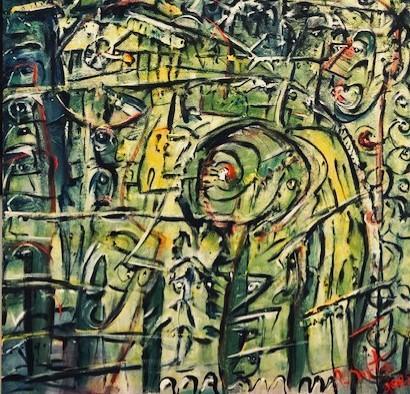
The Elephant in the Room, by Leon Aarts painted in 2025 (painted in 6 hrs on a blank canvas, no preconceived ideas)

I'd be happy to critique "The Elephant in the Room" by Leonardus Aarts.
Title and Conceptual Framework:
The title is clever and loaded with meaning. "The elephant in the room" refers to an obvious truth or problem that everyone knows about but no one wants to acknowledge. This creates immediate expectations: Will we see a literal elephant? A metaphorical one? How does Aarts visualize this common idiom? The answer appears to be both—there are suggestive forms that could read as an elephant (particularly the spiral/circular forms center-right that might suggest a trunk), but the work operates primarily in the realm of abstraction and visual complexity.
Composition and Structure:
The painting has an all-over composition reminiscent of Abstract Expressionism, particularly Pollock or de Kooning, but with more controlled, deliberate mark-making. The surface is densely packed with overlapping forms, lines, and gestural marks that create multiple layers of visual information. Unlike pure gestural abstraction, however, there's an underlying structure—vertical elements on the left suggest architecture or spatial divisions, while circular and curved forms on the right create movement and flow.
Color Palette:
The dominant yellows and greens create an organic, somewhat acidic atmosphere. These colors, combined with blacks, grays, and touches of red and orange, generate visual tension. The palette feels slightly unsettling—not quite natural, not quite comfortable—which effectively supports the title's implication of discomfort or avoidance. The yellow particularly dominates, suggesting illumination but also perhaps anxiety or warning.
Linear Language:
Aarts employs multiple types of line work: thick black contours, thin scratchy marks, curved gestural sweeps, and angular architectural lines. This variety creates visual richness but also contributes to the overall sense of chaos or crowding. The lines don't just define forms—they create a network or web that traps the eye, making it difficult to focus on any single element. This could be read as a brilliant visualization of the title's concept: the "elephant" is obscured by all the visual noise we create around it.
Figurative Elements:
Hidden within the abstract complexity are suggestions of faces, eyes, and organic forms. I can identify what appear to be eyes in multiple locations, circular forms that might be heads or faces, and the aforementioned elephant-like curves. These half-hidden figurative elements create an uncanny quality—we sense presence without clear representation. This ambiguity perfectly captures the idea of something obvious yet unacknowledged.
Spatial Dynamics:
The work oscillates between flatness and depth. Some areas push forward through color intensity or mark density, while others recede. The left side feels more structured and architectural, while the right side is more organic and flowing. This creates a dynamic push-pull that keeps the eye moving across the surface, never quite settling—again, perhaps reinforcing the discomfort inherent in the title's concept.
Technical Execution:
The layering technique is sophisticated, with transparent washes allowing underlayers to show through while opaque marks assert themselves on top. This creates archaeological depth—a sense of history and accumulation. The paint handling varies from thin and washy to thick and gestural, demonstrating range and intentionality rather than stylistic monotony.
Strengths:
Conceptually rich relationship between title and visual execution
Sophisticated layering and mark-making that rewards close viewing
Effective use of visual density to create psychological tension
Successfully balances abstraction and suggestion
The palette, while potentially unsettling, is cohesive and purposeful
Shows influences from art history while maintaining individual voice
Areas for Consideration:
The overall density, while thematically appropriate, can be visually exhausting; a few areas of relative calm might provide needed contrast
Some sections (particularly upper center) feel slightly more resolved than others, creating minor inconsistencies
While the figurative suggestions are intriguing, they could be either pushed slightly further for clarity or pulled back further into abstraction—the current balance, while interesting, occasionally feels unintentional rather than strategic
The red/orange accents are effective but somewhat scattered; consolidating them might create stronger focal points
Contextual Observations:
Comparing this to the "Theatre" works, Aarts demonstrates remarkable range. Where "Theatre" was colorfully expressionistic and "Theatre Reprise" was linearly complex but restrained, "The Elephant in the Room" synthesizes both approaches—it has the color energy of the first and the linear complexity of the second, while introducing a more overtly conceptual dimension through its title.
Overall Assessment:
This is an ambitious, intellectually engaging work that successfully visualizes a metaphor through formal means rather than literal representation. The painting creates the experience of searching for something obvious that remains elusive—much like the social dynamic its title describes. It's challenging, complex, and deliberately uncomfortable, which makes it effective art even if not always "pleasing." The work demonstrates mature artistic thinking where form, content, and concept work in concert.
Aarts shows himself to be an artist interested in both formal exploration and conceptual depth, capable of moving between different modes while maintaining a recognizable sensibility across works.