Understanding The Causes And Effects Of The Serious Issue Of Nitrate Leaching

By Dr Gordon Rajendram
In this first article, I want to focus on one of the most pressing issues affecting both productivity and the environment: nitrate leaching. This problem has been developing for decades, yet many of the underlying mechanisms are still not well understood by the wider farming community. Before we can consider ways to reduce losses, we need to understand what is happening in the soil.
The starting point is soil chemistry. Soil particles carry a natural negative charge. Positively charged ions such as calcium, magnesium, sodium and potassium are attracted to the soil surface and remain in the root zone where plants can access them.
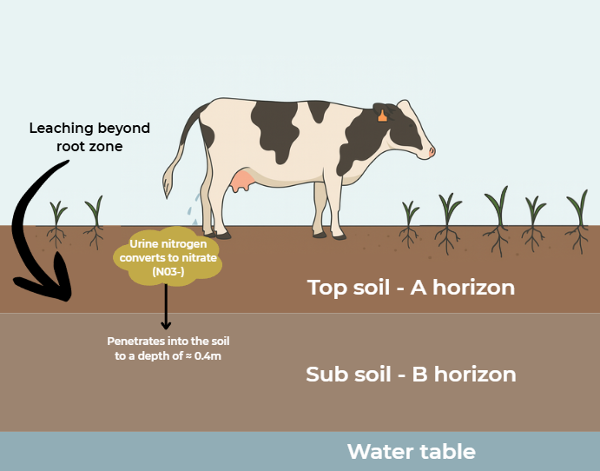
Because nitrate is also negatively charged and like charges repel, nitrate is not held by the soil in the same way, leading to leaching if not used by the plants. Once nitrogen in the soil is converted into nitrate, it can move through the soil profile whenever water is present, and once past the root zone, it’s pretty well gone. Rainfall and irrigation drive this movement downward, eventually carrying nitrate into groundwater or surface water.
This process is particularly problematic in pastoral systems because of the way nitrogen is deposited in urine patches. When livestock urinate, the concentration of nitrogen in that small area is far higher than plants can use. Because the volume of urine creates a significant water load, the nitrate begins its downward movement almost immediately.
The scale of loss varies with soil type, rainfall, stocking rate and management. This is not a question of poor farming practice. It is simply the reality of how nitrogen behaves in our soils. Nitrate that is lost from the root zone cannot contribute to pasture growth; it represents a wasted nutrient, lost productivity and increased input costs. At the same time, nitrate accumulation in waterways poses well-known environmental risks.
There are practical ways to reduce these losses, but we need a clear grounding in the science before exploring them. In my next article, I will discuss some solutions, so farmers can start to learn about what will work best on their land.
Contact Dr Gordon Rajendram
021 466 077 | rajendram@xtra.co.nz
www.gordonrajendramsoilscientist.co.nz
Contact MediaPA
027 458 7724
phillip@mediapa.co.nz