Ways to Reduce Nitrate Leaching Part 1

By Dr Gordon Rajendram
In the previous article, I outlined why nitrate leaching occurs and why it is so difficult to control. Now, I will look at some of the practical options that can help reduce losses. These are not silver bullets, and they are not all suitable for every farm, but each can play a role.
One option is to reduce cow numbers. From a purely scientific point of view, fewer cows mean less nitrogen entering the system, and therefore less nitrate leaching. However, I need to be very clear that simply reducing stocking rates is usually not economically viable on its own. Without major system changes, farm income often drops to a point where the business becomes unsustainable. It may reduce leaching, but it is not a realistic standalone strategy for most farmers.
Pasture typically contains 3% nitrogen (approximately 18% protein). If you apply nitrogen fertiliser, these levels can get up to 5.5%, and the excess N gets excreted by the animal.
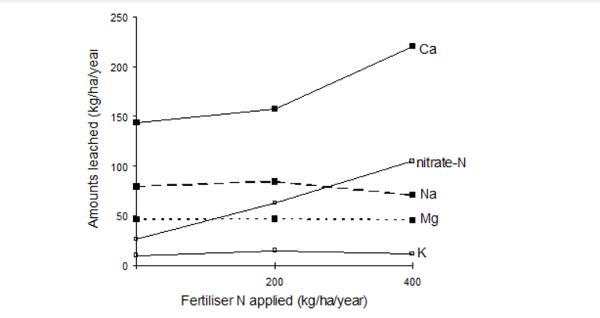
[Text Box: Fig.1: Amounts of nutrients leached with increasing rates of nitrogen fertiliser application at DRC No. 2 dairy, Hamilton in 1996. The SED for comparison between N treatments is Ca (29), Mg (8), Na (10), K (6) and nitrate-N (29).] This work of mine showed that the amounts of nitrate-N, calcium leaching went up with increasing rates of N applied at DRC No. 2 dairy during 1996.
The key takeaway here is: The less nitrogen applied, the less nitrate leached.
Another option is keeping cows off pasture for part of the day using feed pads. Urine patches are one of the biggest drivers of nitrate loss. A 500-kilogram cow can excrete close to 10% of its body weight each day, which equates to around 50 kilograms of dung and urine. If cows are kept off pasture for roughly a third of the day, nitrate leaching from urine patches can be reduced significantly. Whilst this can result in large reductions in nitrate loss, it does come with costs such as infrastructure, additional management time and feed handling. It is an effective tool, but it must be carefully considered.
Diet also plays an important role. The key point here is that feeding more carbohydrates reduces the amount of nitrogen excreted in urine. Supplements such as grain or palm kernel are lower in nitrogen. If you substitute more carbohydrates for pasture, the total nitrogen entering a cow’s system is lowered. This dilution effect means less excess nitrogen is excreted in urine and less nitrate is available to leach.
All of these options show that nitrate leaching can be influenced through management changes. In the Canterbury region, I am working with a farmer using a combination of these approaches, and the measured nitrate losses are very low. In the next article, I will focus on soil and plant-based tools that can be used alongside these management strategies to further reduce nitrate leaching.
Contact Dr Gordon Rajendram
021 466 077 | rajendram@xtra.co.nz
www.gordonrajendramsoilscientist.co.nz
Contact MediaPA
027 458 7724
phillip@mediapa.co.nz