What Zero-Click Search Means for Christchurch Businesses

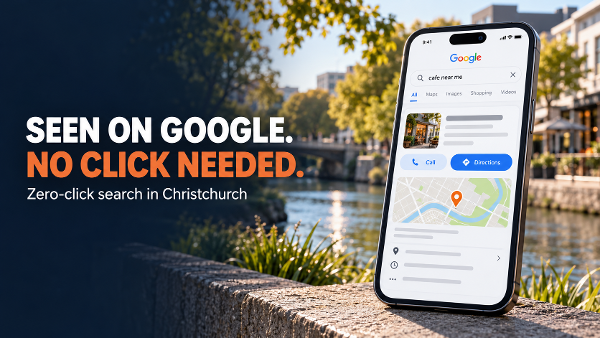
A growing number of Google searches now end without the searcher clicking through to any website. The answer appears on the results page itself, and the person moves on. They might call a business, get directions or simply have their question answered.
This is known as zero-click search. For Christchurch businesses, it changes what online visibility looks like and how its value should be measured.
A cafe owner in Lyttelton, a physiotherapist in Sumner or a plumber in Rolleston can now be seen, trusted and even phoned by a customer without their website ever recording a visit. Website traffic alone no longer tells the whole story.
What counts as a zero-click search
Google now answers many searches directly on the results page. Several features can satisfy a query before the searcher reaches any website:
- Featured snippets, which display a short answer at the top of the results
- People Also Ask boxes, which expand to show answers to related questions
- Knowledge panels and business information boxes
- The local map pack, with call buttons, opening hours and directions
- AI Overviews, which summarise an answer and link to supporting sources
Someone searching for the Sunday opening hours of a Merivale cafe, or for an emergency plumber who is open now, may have everything they need before they scroll. The searcher is satisfied, and the click never happens.
This is not Google working against businesses. It reflects what people want from a search: a fast, reliable answer, particularly when they are on a phone and need help quickly.
Visibility still has value without a click
A searcher who sees a business named as the answer has still encountered that business instead of a competitor.
If a Christchurch electrician’s content is quoted in a People Also Ask answer, the searcher has seen the business name alongside useful, accurate information. If a Riccarton dental clinic appears in the map pack with strong reviews and a call button, a patient may phone directly from the listing.
Google’s documentation on AI features in Search describes AI Overviews as providing a quick answer along with links for people who want to explore further. Being cited as a source therefore carries value even before anyone follows the link.
The goal of local search is broadening. Ranking as the top link remains important, but being the trusted source that Google names in its answer is increasingly valuable too.
There is an honest trade-off
Zero-click search does have a downside. Some questions will be answered so completely on the results page that the business providing the answer loses the visit.
If a website publishes a simple fact that Google can quote in full, it should expect fewer clicks for that particular search.
The practical approach is to answer quick questions briefly and well, so the business becomes the source Google quotes. The more valuable detail should stay on the page itself, where people have a reason to arrive. This includes:
- Pricing guidance and the factors that affect cost
- Worked examples and completed local projects
- Proof of qualifications and experience
- Information specific to Christchurch and Canterbury conditions
- Clear next steps for booking or requesting a quote
A short answer earns the visibility. The depth on the page earns the enquiry.
Website traffic is no longer the whole scorecard
For years, online marketing success was judged largely by search rankings and click-through traffic. That approach now misses a significant part of what is happening.
Consider a Sumner physiotherapy clinic. It ranks well for local searches, its content is quoted in a People Also Ask answer, and it appears in the map pack with a call button. A patient reads the answer, recognises the clinic’s name and phones directly from the map listing.
The website analytics show nothing. The booking is real.
A business looking only at website sessions might conclude that its online visibility is declining, when in fact customers are finding it and making contact through other routes.
A worked example from Lyttelton
Imagine a Lyttelton cafe notices that its website visits for the search “Lyttelton cafe open Sunday” have dropped. At the same time, its Google Business Profile shows a steady number of direction requests.
Nothing is wrong with the website. People are getting the opening hours, a photo and directions from the listing itself, then walking through the door.
The mistake would be to chase website traffic for that search. A better response would be to:
Keep opening hours accurate, including public holidays
Add recent photos of the food, the space and the view
Make sure the website offers what a listing cannot, such as the full menu, dietary options and group bookings
The listing does the job of getting customers through the door. The website does the job of answering the questions that bring them back or turn a coffee stop into a group booking.
How to tell if zero-click visibility is working
Without a click to track, the impact of zero-click search cannot be measured directly. However, several signals can show whether a business is being seen:
- Search Console impressions. A page with strong impressions but unusually low clicks for a specific query may be getting answered on the results page. This is not automatically a problem.
- Google Business Profile insights. Calls, direction requests and website taps show how people are acting on the listing itself. Local visibility often converts without any click to the website.
- Branded searches. An increase in people searching for the business by name can follow from being seen elsewhere, although other factors can also cause it.
- Asking customers. Adding a “how did you find us?” question to enquiry forms and phone calls remains one of the most reliable attribution methods available.
None of these signals proves cause on its own. They are most useful when read together, over several weeks rather than several days. Businesses should look for patterns and avoid expecting a clean line from one change to one result.
Google Business Profile is a zero-click asset
For local businesses, the map pack is one of the most important zero-click features. Many customers will make a decision based entirely on what they see in the listing.
This makes an accurate, complete Google Business Profile essential. It should include:
- The correct primary business category
- Accurate opening hours, updated for holidays
- A current phone number
- Genuine photos of the business, team and completed work
- Services and service areas
- Recent, regularly monitored customer reviews, with responses
An outdated phone number or incorrect opening hours can cost a business a customer before that customer ever thinks about visiting the website.
What Christchurch businesses can do now
Zero-click search does not require a completely new marketing strategy. It does call for a few practical adjustments:
Answer common customer questions clearly and concisely, so the business is the one quoted.
Keep Google Business Profile information accurate and up to date.
Include proof, local detail and clear next steps on every important page, so those who do click have a reason to enquire.
Track phone calls, enquiry forms and booking requests, not only website sessions.
Review existing content for quick answers that give everything away, keeping the short answer but holding back the worked examples, pricing guidance and local detail for the page itself.
The fundamentals still decide who gets quoted
Featured snippets, People Also Ask answers, map pack listings and AI Overviews all draw on the same relevant, trustworthy pages that good SEO builds.
A technically sound website, useful content written for real customer questions, a complete Google Business Profile and a steady flow of genuine reviews support visibility in traditional search results and zero-click features alike.
Zero-click search is not a reason to abandon the basics. It is a reason to measure more than clicks.
Christchurch SEO, a local digital growth project operated by EightySix Digital, helps Christchurch and Canterbury businesses improve their visibility across Google search, Maps and AI-powered search platforms. Its full guide, What Is Zero-Click Search and What It Means for Christchurch Businesses, covers the topic in more detail.
For local businesses, the question is no longer only whether customers clicked. It is whether the right customers saw the business, trusted what they saw, and got in touch.