Golf Ball Position: Why One Ball-Width Costs 22 Feet (According to the Research)

AUCKLAND, NEW ZEALAND. 27 October 2026.
Golf ball position is the setup detail most weekend golfers never measure, and the research says it is quietly costing them fairways and greens. Golf company Divot Works has studied the peer-reviewed studies on ball position and stance width in depth, and the numbers explain why so many "swing" problems begin before the club moves.
How Much Does Ball Position Matter?
It matters more than most golfers expect. A 2018 motion-analysis study of professional golfers found that moving the ball just half a ball-width in the stance changed shoulder alignment, foot pressure and club face angle at impact. For these professional-level golfers who can compensate better than most amateurs, one ball-width of ball position change adds up to 22 feet to 7-iron dispersion and can shift carry distance by up to half a club (Kim et al. 2018). So if that's what happens for the Pro's, imagine what an inconsistent ball position is doing to your game?
The driver is even more sensitive. Research published in the Scandinavian Journal of Medicine and Science in Sports showed that a quarter of an inch of ball position change is enough to move driver launch angle outside the optimal window (Bradshaw et al. 2013). At a typical amateur club speed that is around 15 yards of carry.
The Gap Between Professionals and Amateurs
Professionals repeat their setup with remarkable precision. One study measured tournament-level golfers standing the same distance from the ball with variation of only a few millimetres. Amateurs with a handicap around 20 showed 35 percent more variation in ball position than scratch golfers, and 42 percent more variation in stance width (Langdown et al. 2013).
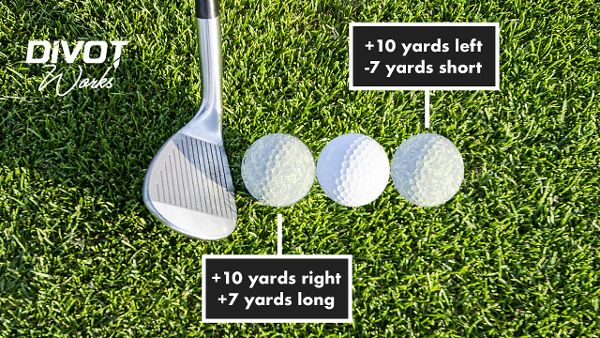
The practical conclusion of the review is that a golfer who held ball position for irons to within a quarter of an inch could expect roughly 7 yards less front-to-back dispersion and around 10 yards less left-to-right dispersion with mid irons, without changing anything about their swing.
The full technical review of the golf ball position research, with the studies cited, is published on the Divot Works website.
Why One New Zealand Company Built a Product Around It
Divot Works founder Andrew Norman says the research changed how he thought about practice. "Golfers spend their range time on the swing, but the studies show a lot of the inconsistency is baked in before the backswing starts. We built Stance IQ because there was no simple way to practice the same stance width and ball position consistently for each club."
The company's view is that setup consistency is not a quick fix. It is one piece of a very large, complex puzzle (that is the golf swing), but one of the best pieces to start with, because it removes variation that the swing otherwise has to compensate for.
About Stance IQ
Stance IQ is a golf setup training mat that shows the correct stance width and ball position for each club (driver, woods, long irons, mid irons, short irons and wedges), sized to your height across six sizes. Lay it down on the range or during your warm-up, line up your feet and the ball with the markings, and build a setup you can repeat on the course. Designed and made in New Zealand by Divot Works. Patent pending. Founder: Andrew Norman. More at divotworks.co.
Research cited: Kim et al. 2018 (motion analysis of ball position in professional golfers); Bradshaw et al. 2013 (driver launch conditions, Scandinavian Journal of Medicine and Science in Sports); Langdown et al. 2013 (setup variability in skilled and less-skilled golfers).