Love, Fear and the Architecture of Consciousness- A personal reflection

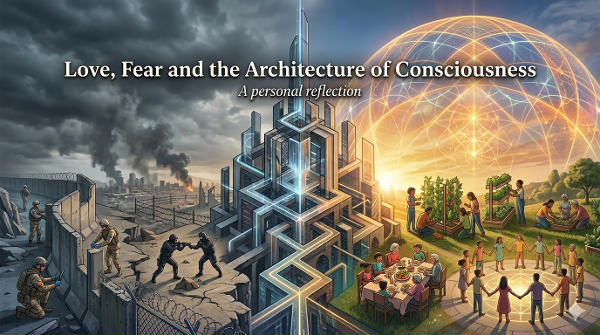
One of the most important realisations emerging from my recent research is that the recurring problems of humanity may not originate in governments, political parties, religions, corporations or even individuals. These are expressions of something deeper. They are reflections of consciousness itself.
For many years I watched the world through a political lens. I protested. I started my own magazine – streetalk. I questioned authority. I followed environmental issues and social issues closely. I believed, as many do, that if enough people stood up and spoke out, the systems would change.
Yet after decades of observation, I’ve noticed something troubling. The same patterns kept reappearing, generation after generation, even when governments changed, leaders changed, parties changed and policies changed. Fear, division, conflict, corruption and war continued to emerge under new names, new faces, new banners.
This raised a deeper question: What if the problem is not the system itself, but the consciousness that continually recreates the system?
I’ve been re-reading Seth’s Unknown Reality Volumes 1 & 2. His discussion of humanity’s ancient movement into separation offered me a framework I had never encountered before.
..”.. When, in historic terms, the race was in the process of adopting a necessary artificial separation of itself from the rest of nature; when it needed to be assured of its abilities to do so; when it took upon itself the task of a particular kind of specialization and individual focus, it needed a religion that would assure it of its abilities. The male-female tendencies at that time became psychically alienated from each other. The differences were exaggerated. The ancient mother-goddess concept became "unconscious"; the male, purposely forgetting the great natural aggressive thrust of birth, took physical aggression and force as his prerogative – for this came to represent the quality of ego consciousness in its need to physically manipulate its environment.
While it (ego consciousness) recognized its deep oneness with the earth and all creatures, it could not at the same time develop those abilities of specialization and its own particular unique focus. The growth of separate tribal cultures, for example, and later of nations, could emerge only through a sense of separation, and a certain kind of alienation. This, however, allowed for a diversity that could not otherwise be achieved under the accepted conditions…”
Humanity gradually specialized its consciousness. Individual identity strengthened. The ego emerged as a powerful organizing force. The price of this development was a growing sense of separation from nature, from one another, and from our own deeper identity.
For most of the modern era, classical science reinforced this sense of separation. By focusing almost exclusively on the objective, measurable world, it achieved astonishing success in medicine, engineering, technology and exploration. Yet it had a persistent blind spot: consciousness itself. Science became extremely skilled at describing what reality does, while struggling to explain the observer — the conscious experiencer. What is consciousness? Where does it come from? Why does matter become experience? For a long time the assumption was that consciousness emerges from complex physical processes — an accidental by-product of biological life.
But this view is now being profoundly challenged. A growing number of serious thinkers suggest the reverse may be true: that life and matter emerge from consciousness, rather than the other way around. This reversal is enormous in its implications.
Physicist and computing pioneer Federico Faggin is particularly compelling to me. After a deep personal experience of expanded awareness, he concluded that consciousness is not generated by the brain but is fundamental to reality itself. The brain participates in consciousness rather than produces it. Others, such as Maria Strømme, are working to build bridges between physics and non-dual understanding, attempting to map and even formalize these ideas.
While I resonate more with Faggin’s direct experiential knowing, both point to the same emerging realization: reality may be more relational and conscious at its core than our classical frameworks allowed.
Whether one accepts these ideas literally or symbolically, the pattern is clear. When consciousness experiences itself as fundamentally separate, certain behaviours naturally follow:
Fear becomes dominant.
Protection becomes more important than relationship.
Competition replaces cooperation.
Judgement replaces understanding.
Control replaces trust.
Domination replaces partnership.
The “other” becomes a threat rather than a participant in a shared reality.
Over time entire societies become organized around these assumptions. Our social structures, institutions and even our ways of relating have been deeply informed by this narrow materialist view — by not fully knowing ourselves, by separating from our own deeper nature. This has helped create a fearful world, even though cooperation, relationship and love are constantly operating beneath the surface, largely unseen.
What strikes me now is that the contrast between love and fear is not merely emotional. They are fundamentally different ways of organizing reality. Take a moment to ponder this and then look around at the world, our country, our beliefs, our emotions, our lives
Love tends toward relationship. Fear tends toward separation.
Love expands awareness. Fear contracts awareness.
Love seeks understanding. Fear seeks certainty.
Love recognises connections. Fear emphasizes difference.
Love encourages cooperation. Fear encourages competition.
Love invites participation. Fear demands control.
Seen this way, love is not simply a pleasant feeling. It is a mode of consciousness.
Likewise, fear is not simply an emotion. It is also a mode of consciousness. Each creates a different world.
The news media demonstrates this every day.
A bombing is reported.
A murder is reported.
A scandal is reported.
A disaster is reported.
A conflict is reported.
The unusual, dramatic and threatening naturally attract attention. Meanwhile countless acts of cooperation remain invisible.
Millions of people care for children.
Millions support friends.
Millions tend gardens.
Millions help neighbours.
Millions work together peacefully.
Millions solve problems collaboratively.
These events rarely become headlines. As a result, we are presented with a distorted image of reality.
Not a false image, tragedies are real, but they are disproportionately represented. The extraordinary violence of a few individuals is displayed repeatedly while the ordinary cooperation of millions remains largely unseen, largely unacknowledged, not added into the equation of the totality of human experience.
Fear therefore appears normal. Relationship appears exceptional. Yet the opposite may actually be true.
Humanity itself, its systems its institutions, its organizations on every level depends upon cooperation. Indeed, we are all in relationship at fundamental levels.
The food reaches the supermarket because thousands of people cooperate. Water reaches the tap because thousands cooperate. Electricity flows because thousands cooperate. Communities function because countless relationships operate successfully every day.
The world continues because cooperation is already occurring on a massive scale. In this sense, cooperation is fundamental it is relational, it’s just that we rarely it, or acknowledge it because it’s over shadowed with what is ‘wrong’ in the world
This has led me to reconsider where meaningful change actually begins. For many years I believed change primarily happened through systems. Now I increasingly suspect systems emerge from consciousness. I am beginning to see that a fearful population tends to create fearful institutions. A distrustful population tends to create controlling institutions. A divided population tends to create divisive politics.
Likewise, a population that values relationship, trust and participation gradually creates structures that reflect those qualities.
Its remembering that Governments do not stand outside humanity. They are humanity organized at scale. The collective reflects the individual, and the individual reflects the collective.
This understanding also changes how I view my own reactions. In 2020 just before covid, I had a huge heart opening. I had to undergo open heart surgery to replace a deformed aortic valve. It changed me and over the years I couldn’t fully articulate why – until now. Back then when confronted by injustice, corruption or cruelty, I become reactive, I blamed, I become emotionally entangled in the very consciousness pattern I didn’t like.
Now I realize - Love asks something more difficult, Love asks for coherence It asks me can I remain centered in the presence of fear? Can I respond rather than react? Can I maintain relationship without collapsing into anger or hatred? Can I see suffering without becoming consumed by despair?
I feel that these now may be the most important political acts available to us.
Not because they change the world overnight, they don’t, but because they change the consciousness from which the world is continually being created, and that’s the difference and to me its huge.
Perhaps this is why I keep returning to Seth and the many books he wrote with Jane Roberts. Not because he offers easy answers, but because he places human experience within a developmental context — one that modern consciousness research is now beginning to echo. The world is not simply trapped in endless decline, nor automatically progressing toward perfection. It is unfolding, slowly, painfully, imperfectly. Yet unfolding nonetheless.
And if consciousness created the patterns that produced our current world, then consciousness can also participate in creating something new.
The question is not merely what governments are doing anymore, the deeper and I think bigger question is: What consciousness am I cultivating to help unfold this?
For ultimately, relationship and separation are not only forces operating in the world. They are choices appearing moment by moment within each of us. In this sense, humanity’s next evolutionary step may involve not merely acquiring more information, but developing a deeper understanding of who and what we truly are.
If that proves to be the case, then the greatest frontier before us is not outer space.
It is consciousness itself.
Through understanding consciousness, we may finally begin to understand why the patterns of fear and separation arise—and how the forgotten patterns of relationship, cooperation and love can once again become active forces in the human story