Blood Urea in Cows: Your Questions Answered By Dr Gordon Rajendram

With calving in full swing across Canterbury, here are the blood urea questions I get asked most often.
I'm a soil scientist. Why am I talking about blood tests in cows?
What happens inside a cow's rumen doesn't stay there. It ends up back on the paddock, exactly what I track in the soil all year.
What actually is blood urea nitrogen?
Rumen microbes break dietary protein down to ammonia. What they can't use is converted to urea in the liver, circulating in blood and passing just as freely into milk. That's why blood urea nitrogen (BUN) and milk urea nitrogen (MUN) track each other closely.
Why does this matter more at calving?
Freshly calved cows are often pushed onto high-protein spring pasture before energy intake catches up, the classic recipe for elevated BUN. That excess nitrogen is excreted in urine, landing on the paddock in concentrated patches, the leaching risk I manage in the soil.
It's the same pattern I've watched with potassium and downer cows. Heavy nitrogen fertiliser on calving paddocks drives up pasture potassium, suppressing magnesium and setting up downer cow risk. Push too much N and you load the system twice: potassium-magnesium, and wasted protein. Holding off heavy N addresses both.
What's a healthy milk urea reading?
Most farmers aim for bulk milk urea around 20 to 30 mg/dL. A bulk sample mixes the whole vat, so a herd averaging 25 might have cows ranging 15 to 50. NZ and Australian herds have recorded bulk milk urea between 8.5 and 37.2 mg/dL. Below 17 usually points to a protein shortfall; above 33, and especially 40, is where nitrogen loss risk climbs.
How closely does milk urea track what's excreted?
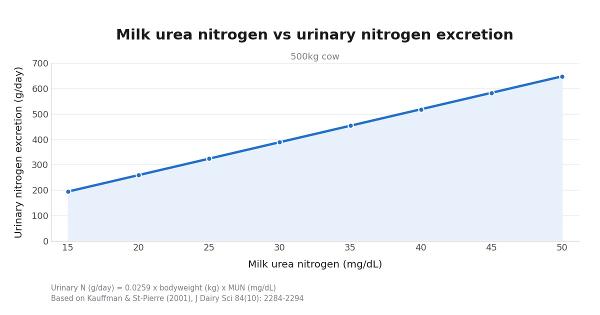
Very closely. Milk urea nitrogen strongly predicts daily urinary nitrogen output. The graph below shows this for a typical 500kg cow, using Kauffman and St-Pierre's 2001 equation: urinary N (g/day) = 0.0259 x bodyweight x MUN. As milk urea climbs from 15 to 50 mg/dL, urinary nitrogen more than triples, from around 194 to nearly 650g a day.
Is there a fertility risk too, around November-December mating?
Elevated blood and milk urea is one of several metabolic markers worth watching in early pregnancy, alongside excessive ketone formation. For herds mated through October-November, the late embryonic and early fetal stage, roughly 30 to 60 days post-conception, falls right in that window. Research on noninfectious pregnancy loss has flagged elevated BUN as a signal that can threaten an established pregnancy.
The takeaway
Urea testing isn't just a calving-time check. It's an early indicator of nitrogen use efficiency on farm, with fertility implications into mating. Get the protein-to-energy balance right, and you set cows up for a better lactation while cutting the nitrogen load on your soil, and protecting the pregnancies you're about to establish.
For more information, please contact:
Dr Gordon Rajendram
Soil Scientist
Phone: 021 466 077
Email: rajendram@xtra.co.nz
Website: www.gordonrajendramsoilscientist.co.nz
Phillip Quay
Media PA
Phone: 027 458 7724
Email: phillip@mediapa.co.nz