What a Blood Test in Your Cow Says About Your River: New Zealand Soil Scientist Dr Gordon Rajendram Explains the Nitrogen Trail

Every cow that grazes New Zealand pasture is part of a nitrogen cycle that stretches well beyond the paddock fence, all the way to the rivers, wells, and drinking water supplies many of us rely on. Understanding that cycle starts with something as simple as a blood or milk urea test.
Here's the simple version. A cow only uses a small share of the nitrogen in the grass or crop she eats, typically somewhere between 5 and 30 percent, depending on how well protein and energy are matched in her diet. The rest, 70 to 95 percent of it, comes straight back out, mostly in urine. That's not a farm inefficiency to be embarrassed about; it's just how a ruminant works. But it does mean that every time a cow urinates, she deposits a small, heavily concentrated patch of nitrogen onto the soil, sometimes at rates equivalent to 200 to 2000 kilograms of nitrogen per hectare, far more than any plant nearby can use.
This is where the blood or milk urea test becomes genuinely useful, not just for animal health, but as an early signal of what's about to land on the ground. Elevated urea in the blood and milk directly reflects elevated urea in urine. So a bulk milk urea reading climbing above the healthy range isn't only a fertility or metabolic flag, it's also a heads-up that more concentrated nitrogen is about to hit the paddock.
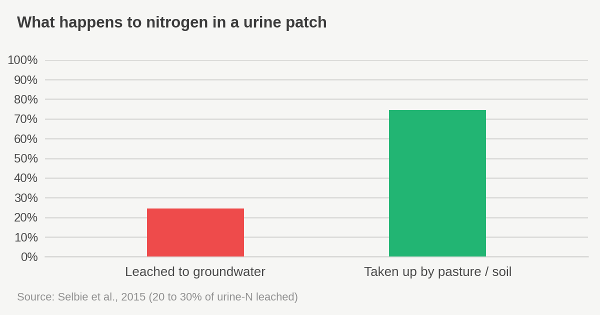
What happens to that nitrogen next matters a great deal here in Canterbury. Research on urine patches shows that of the nitrogen deposited this way, roughly 20 to 30 percent typically leaches down through the soil profile as nitrate, ending up in groundwater. That's the same nitrate that shows up in well tests, and in some Canterbury catchments, in drinking water supplies. It isn't the only source of nitrate in our groundwater, but it's a well-studied and meaningful one.
The reassuring part is that this isn't a fixed outcome. Nitrogen use efficiency is something farmers can genuinely influence, through better protein and energy balance in spring diets, through timing of nitrogen fertiliser away from wet, high-leaching periods, and through pasture species choices that dilute urine nitrogen concentration. Getting the diet right so blood and milk urea sit in the healthy range isn't just good for the cow. It's one of the more direct levers a farm has over what ends up in the water table.
Next time you see a milk urea result on a test sheet, it's worth remembering it's telling you two things at once: how well a cow's protein and energy are balanced, and roughly how much nitrogen is about to head for the soil.
References
- Selbie, D.R., Buckthought, L.E. & Shepherd, M.A. (2015). The challenge of the urine patch for managing nitrogen in grazed pasture systems. Advances in Agronomy, 129, 229–292.
- Di, H.J. & Cameron, K.C. (2002). Nitrate leaching in temperate agroecosystems: sources, factors and mitigating strategies. Nutrient Cycling in Agroecosystems.
- Cameron, K.C., Di, H.J. & Moir, J.L. (2013). Nitrogen losses from the soil/plant system: a review. Annals of Applied Biology.
- Aitchison-Earl, P. Sources of nitrate in groundwater, Canterbury Plains studies (referenced in NZIAHS review of the urine patch and groundwater quality).
For more information, please contact:
Dr Gordon Rajendram
Soil Scientist
Phone: 021 466 077
Email: rajendram@xtra.co.nz
Web: https://www.gordonrajendramsoilscientist.co.nz
Media enquiries:
Phillip Quay
Media PA
Phone: 027 458 7724
Email: phillip@mediapa.co.nz