What Is Office Window Tinting?

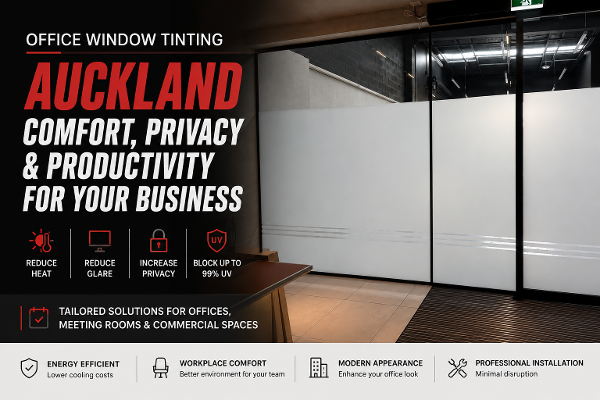
Office window tinting involves applying a specialised architectural film to existing glass. Depending on the product, the film may be clear, lightly tinted, reflective, frosted or almost completely opaque.
Commercial films can be selected to provide one or more functions:
Solar heat control
Glare reduction
UV protection
Daytime privacy
Meeting-room privacy
Decorative branding
Glass safety
Security reinforcement
Applied window films are recognised in New Zealand as a way to modify the performance of existing glazing. Film selection, glass compatibility, installation and warranty should all be considered before the work begins.
Why Auckland Offices Become Too Hot
Auckland offices with large north- or west-facing windows can receive strong direct sunlight throughout the day.
Solar energy entering through the glass can create:
Hot areas beside windows
Uneven temperatures across the office
Increased air-conditioning use
Uncomfortable meeting rooms
Afternoon heat build-up
Staff moving away from sunny workstations
Solar-control window film helps reduce solar heat gain while allowing businesses to keep their existing windows and natural light.
New Zealand building guidance notes that solar films can reduce glare, solar heat gain and interior fading.
Benefits of Office Window Tinting
1. Reduced heat and improved comfort
Solar-control film helps reduce the amount of solar energy entering through office windows.
This may create a more consistent temperature throughout the workplace, particularly in rooms exposed to strong afternoon sunlight. It can be useful for:
Open-plan offices
Meeting rooms
Reception areas
Showrooms
Staff rooms
Co-working spaces
Street-facing commercial buildings
HLWrap offers commercial film options designed to reduce heat and lower the cooling demand created by large areas of glazing.
2. Less glare on computer screens
Screen glare can make it difficult for employees to work comfortably. WorkSafe New Zealand identifies overly bright lighting and screen glare as factors that may contribute to discomfort for computer users. It recommends taking steps to control glare and avoiding monitor placement directly in front of bright windows.
Anti-glare window film can reduce harsh visible light without requiring blinds to remain closed throughout the day. This allows offices to retain:
Natural light
Outside views
A more open atmosphere
Better use of workstations near windows
3. UV protection
Suitable commercial films can block up to 99% of ultraviolet radiation. UV exposure contributes to the fading and deterioration of:
Carpet
Timber flooring
Office furniture
Curtains
Artwork
Product displays
Interior signage
HLWrap’s commercial window tinting range includes films offering UV protection for offices, shops and showrooms.
4. Daytime privacy
Reflective and dual-reflective films can reduce visibility into an office during daylight. This is useful for:
Ground-floor offices
Street-facing workspaces
Reception areas
Clinics
Showrooms
Staff areas
Buildings close to neighbouring properties
Daytime privacy film works best when it is brighter outside than inside. At night, when office lights are on, people outside may still be able to see through the glass. Blinds, curtains or frosted film may therefore be needed where complete privacy is required after dark.
5. Meeting-room and partition privacy
Reflective and dual-reflective films can reduce visibility into an office during daylight. This is useful for:
Ground-floor offices
Street-facing workspaces
Reception areas
Clinics
Showrooms
Staff areas
Buildings close to neighbouring properties
Frosted film diffuses the view while still allowing natural light to pass through. It can also be contour-cut with:
Company logos
Patterns Stripes
Room names
Decorative graphics
Safety manifestation bands
Unlike permanently etched glass, frosted film can normally be removed or replaced when an office tenant, layout or brand identity changes.
6. A more professional appearance
Commercial window film can improve the appearance of mismatched or overly clear office glazing. Depending on the product, it can create:
A neutral modern finish
A reflective exterior appearance
Consistent privacy across multiple windows
Branded meeting-room glass
A cleaner shopfront or reception area
The design should suit the property, surrounding buildings and the amount of natural light the business wants to retain.
Types of Office Window Film
Solar-control film
Solar-control film is designed to reduce heat, glare and UV exposure. It is suitable for offices where comfort is the main concern. Options range from lightly tinted films to high-performance products that provide stronger solar rejection.
Clear or spectrally selective film
Clear or nearly clear films are useful when businesses want heat and UV control without making the windows appear significantly darker. They are often suitable for:
Modern office buildings
Showrooms
Properties with appearance restrictions
Businesses wanting to preserve natural daylight
High-performance films can provide solar control without excessively reducing visible light.
Reflective window film
Reflective film offers stronger daytime privacy and can significantly reduce glare and solar heat. It is often chosen for:
West-facing offices
Street-level workplaces
Commercial buildings with large glass façades
Rooms affected by strong direct sunlight
The reflective appearance should be considered carefully because it changes how the building looks from outside.
Dual-reflective film
Dual-reflective film typically has a more reflective exterior surface and a softer interior appearance. This can provide:
Strong daytime privacy
Heat control
Reduced internal reflection
Improved outward visibility compared with some fully reflective films
Frosted privacy film
Frosted film is primarily used for privacy and design rather than maximum heat rejection.
It works well for internal partitions and rooms where privacy is needed throughout the day and night.
Safety and security film
Safety or security film is thicker than ordinary solar-control film. It is designed to help hold broken glass together after impact.
Depending on the complete installation system, it may help reduce the risks associated with:
Accidental breakage
Flying glass fragments
Opportunistic entry
Impact damage
Safety film should be selected according to the building, glass type and level of protection required.
How Much Does Office Window Tinting Cost in Auckland?
The cost of office window tinting depends on the project rather than one fixed price. The main pricing factors include:
Total glass area
Film type
Number and size of panes
Window height Access requirements
Single or double glazing
Existing Low-E coatings
Removal of old film
Internal partitions or external windows
Custom frosting or printed graphics
Security-film thickness
Work required outside normal business hours
We have a price estimator calculator to help you. Click Here for an Estimation.
Commercial projects may also require ladders, scaffolding, elevated platforms or additional safety planning. HLWrap provides on-site assessments and written commercial quotes based on the glass, access and chosen film.
Can Office Window Film Reduce Energy Costs?
Window film can reduce solar heat gain, which may lower the cooling load in sun-exposed office areas. However, the actual energy saving depends on:
Building orientation
Total glass area
Existing glazing
Film performance
Air-conditioning system
Occupancy Auckland weather conditions
How the office is used
It is better to describe energy savings as a possible benefit rather than promise a specific percentage.
Commercial-window technologies that reduce solar gain can contribute to lower cooling demand, but results are building-specific.
How Long Does Commercial Window Film Last?
The lifespan depends on:
Film quality
Interior or exterior installation
Sun exposure
Glass orientation
Cleaning methods
Environmental conditions
Manufacturer warranty
We have a price estimator calculator to help you. Click Here for an Estimation.
HLWrap states that quality interior architectural films may last approximately 10–15 years or longer, while exterior films often have a shorter lifespan because they are exposed directly to weather. Actual warranty terms vary by product.
Final Thoughts: Office Window Tinting Auckland
Office window tinting can be a practical way to improve comfort, glare control, privacy and UV protection without replacing the existing glass.
Solar-control film is ideal for hot, sun-exposed offices. Reflective film provides stronger daytime privacy, while frosted film is better for meeting rooms and internal glass partitions.
For professional office window tinting in Auckland, contact HLWrap for an on-site assessment and tailored quote.
Wanted to have free quote? contact us at HLWrap — we’re here to help!
FAQ:
Does office window tint work at night?
Solar and reflective films mainly provide privacy during daylight. When it is darker outside and lights are on inside, people may be able to see in. Frosted film or blinds are better for consistent night privacy.
Can office window tint reduce computer-screen glare?
Yes. Solar-control and glare-reduction films can reduce bright sunlight reflected on screens. The selected shade should balance glare control with the amount of daylight employees need.
Can window film be installed without closing the office?
Often, yes. Smaller installations can usually be completed with limited disruption. Larger projects can be divided into sections or scheduled outside busy periods.